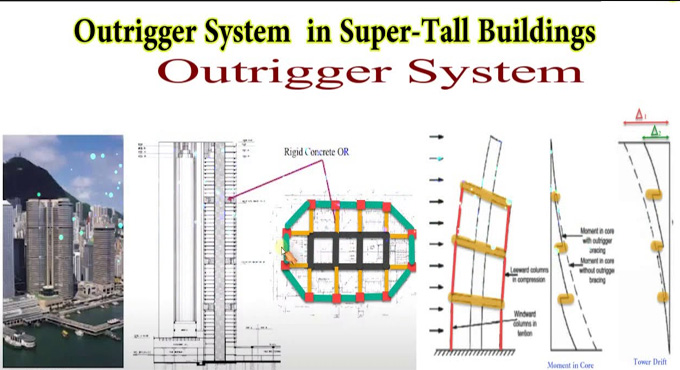

Different types of outrigger system in high-rise buildings
The outrigger system refers to the lateral load-resisting system, in which the external peripheral columns have been tied to the central core along with very stiff outriggers and a belt truss. In this context, the belt trusses have been tied to the peripheral columns of the building structure, while the outrigger system engages them with the central or main shear wall.
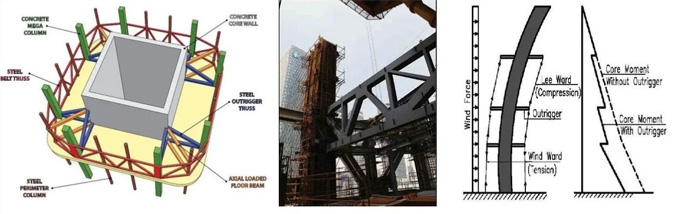
The outrigger system has been commonly used as one of the structural systems to efficiently control excessive drift due to lateral load. As a result, the risk of structural or non-structural damage due to wind or earthquake has been minimised. The structural response of the outrigger system has been based on the drift due to the lateral load that has been induced in the outer columns of the building structure.
Discuss the different types of the Outrigger System
On the basis of the connectivity to the core, the outrigger system has been characterised into two types, which are as follows:
Conventional Outrigger System
In this type of outrigger system, the outrigger trusses have been connected to the shear wall or braced frames directly at the core to the column that has been located outboard of the core. In this context, the number of outriggers has been varied from one to three or more over the height of the building structure. The outrigger trusses that have been connected to the core help to restrain the rotation of the core and convert part of the moment in the core into a vertical couple at the columns of the building structure. The shortening of the building column and deformation of the trusses will allow rotation of the core at the outrigger.
Virtual Outrigger System
In the case of the virtual outrigger system, the transfer of overturning moment from the core to the peripheral columns has been achieved without any direct connection between the core and the peripheral columns. This virtual outrigger system has been achieved by using the floor diaphragms, which help to transfer overturning moment in the form of a horizontal couple from the core to the outboard. In this context, a belt truss connecting the peripheral has also been added.
Role of the Outrigger System in Tall Structures
1. The outrigger system has been widely used in structural mechanisms in tall building structures, which helps to enhance the structural stability of the building structure, as well as the resistance power against the lateral forces, for example, wind forces and seismic loads. In this context, the outrigger system consists of a rigid horizontal element, which helps to connect the central core or spine of the building to the outer perimeter columns.
2. The outrigger system helps to create a coupling effect among the core and external columns in the tall building structures, which helps to reduce the overall lateral deflection, as well as enhances the stiffness of the tall building structure.
3. The outrigger system also helps to improve the efficiency of the structural framework by distributing the lateral forces more evenly. Thus, the outrigger system helps to reduce the demand on the core.
4. The outrigger system has been composed of steel trusses, reinforced concrete and several composite materials, on the basis of the structural requirements of the tall building structure.
5. There are multiple levels of outrigger floors that have been used often in modern tall building structures, which helps to maximise their stability.
6. The use of dampers along with the outrigger system helps to reduce vibrations during strong winds or earthquakes, which helps to enhance the occupant comfort.
7. The outrigger system also allows for more flexible architectural designs for the tall building structures by minimising the requirements for bulky internal columns; as a result, larger and open floor spaces have been achieved.
8. The adaptability, cost-effectiveness, and efficiency in reducing lateral movements of the outrigger system help to make this system an essential technology in the high-rise building structure, which helps to promote the structural longevity and safety of those building structures.
Learn about the Truss Structural Load
The truss structural loads refer to those forces which act on the truss system of the building's structure, resulting in interconnected triangular members experiencing axial tension or compression. The truss structural loads help to allow the trusses to span long distances and also help to support heavy weights, along with minimal material. Thus, truss structural loads are ideal for bridges, roofs or towers.
To learn more, watch the following video tutorial.
Video Source: The Constructor - Civil Engineering Home
The truss structures support the maximum load before failure, and this load has been determined by the strength of the materials used in the structure, the design of the truss structure and also adherence to building codes. The entire truss structural loads travel through the members to the joints and to the supports, including walls and columns, and it has been transferred safely to the ground.