
Components of Bridge and their Functions
A bridge is the connecting structure which helps to create a bond between the different connected parts of the countries, or between the two banks of the oceans. The bridge has been used to pass any type of obstruction, which can slow down the lives of the people. The bridge has come in different sizes and designs based on the specific purposes and the challenges of its location.
Discuss the different component parts of a bridge
The entire bridge structure has been divided into three main parts, which are:
The foundation structure
This part of the bridge structure lies beneath the ground.
Open foundation
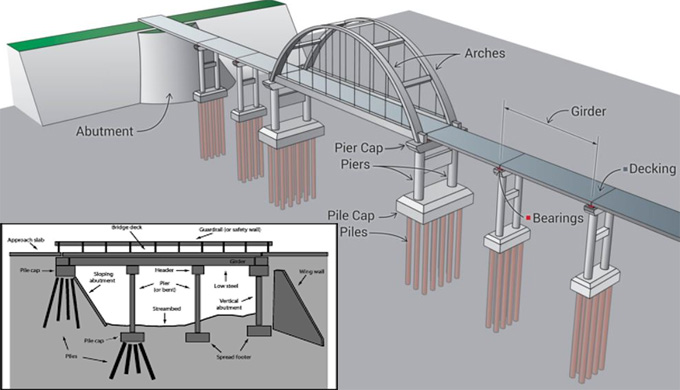
The open foundation structure is similar to the shallow footing in buildings. The open foundation of the bridge helps to resist the punching shear and direct shear transferred from piers above.
Piles
The piles have been used to provide support to the bridge structure, thus making the initial foundation for the bridge. The piles help to transmit the weight and stresses of the bridge structure through the ground, thus helping to make the bridge stable and strong.
Pile caps
The pile cap is the thick reinforced concrete slab, which has been constructed on top of the group of concrete foundation piles. The pile cap helps to provide additional load transferring capacity to the piles of the bridge structure.
Sub structure
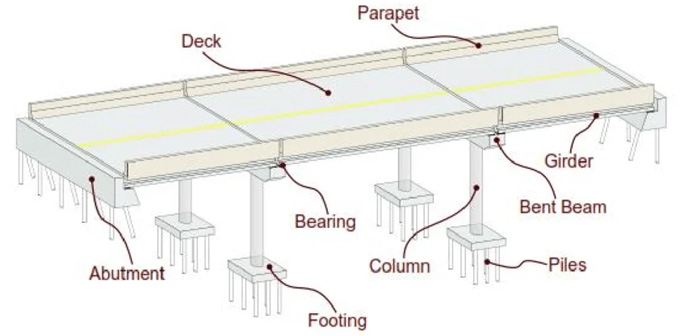
The substructure of the bridge includes the piers, crash barriers, pier caps, pedestals, and bearings.
Piers
The bridge piers help to support the span of the bridge and also help to transfer the entire load of the bridge structure from the superstructure to the foundation. The pier of the bridge should be strong enough to support both vertical and horizontal loads.
Piercaps
These are the flag members of the bridge substructure, which can host the girders via the bearing pedestals.
Bearing pedestals
The bearing pedestals of the bridge substructure are the rectangular members that have been integrated as part of the main pirecap at the top.
Bearings
These are the structural members of the bridge substructure, which are capable of transferring the loads from the deck of the bridge to the bridge substructure. The bearings of the bridges help to displace the stresses and loads to the piers of the bridge through the girders, which helps to allow the movement between the parts of the bridge.
Seismic arrestors
The seismic arrestors help to bear the impact of seismic forces on a bridge structure.
Vertical bearings
The vertical bearings have been placed vertically as an interface between the girder and the seismic arrestors, which helps to avoid rupture of the concrete.
Super structure
The entire viaduct of the bridge is the superstructure.
Girders
The girders help to support the deck slab for the traffic, which can be likened to the beams that are constructed in buildings. The girders of the building structure can be a single span, simply supported or can be multiple spans continuing for more than one span.
What is the key importance of the structural elements used in the bridge structure?
The selection of the structural elements of the bridge structure should be done very carefully. In this context, several factors need to be considered, which are as follows:
1. The bridge construction materials should have the ability to handle expected loads without failure.
2. The bridge construction materials should also be resistant to weather or chemicals, to ensure the long-lasting bridge structure.
3. The efficient use of bridge construction materials helps to reduce the overall cost of the bridge construction project without compromising safety.
4. Those bridge construction materials should be used which require low maintenance, thus helping to reduce the long-term expenses of the bridge structure.
Learn about the different types of bridge structures
Different types of bridges have been seen throughout the world, which are as follows:
Truss Bridge
This type of bridge has been made with a steel two-force member, along with only tension and compression. In this bridge structure, no bending moment has been allowed. This is the most stable shape of the bridge compared to other types of bridge structures.
Arch Bridges
This type of bridge mainly exists in compression.
Slab Bridges
This is the most common type of bridge, where the span is not so long.
Suspension Bridges
In this type of bridge structure, long spans have been provided, which provide freedom to the engineer to provide a long span with the help of a cable.
To learn more, watch the following video tutorial.
Video Source: Civil Engineering
Cable-Stayed Bridges
This type of bridge is similar to the suspension bridge structure. In this type of bridge, the vertical loads that act on the girder are carried.
Box Girder Bridges
The box girder bridge contains a vertical web, a top deck, and a bottom slab, which can easily resist a greater amount of torsion.